
There is no final version of AI competence, which is why the AI-ready HR professional is defined by adaptability, not by one tool. New tools will appear, some will disappear, and what looks impressive today will feel ordinary next year. If your confidence depends on mastering one platform, it won’t last.
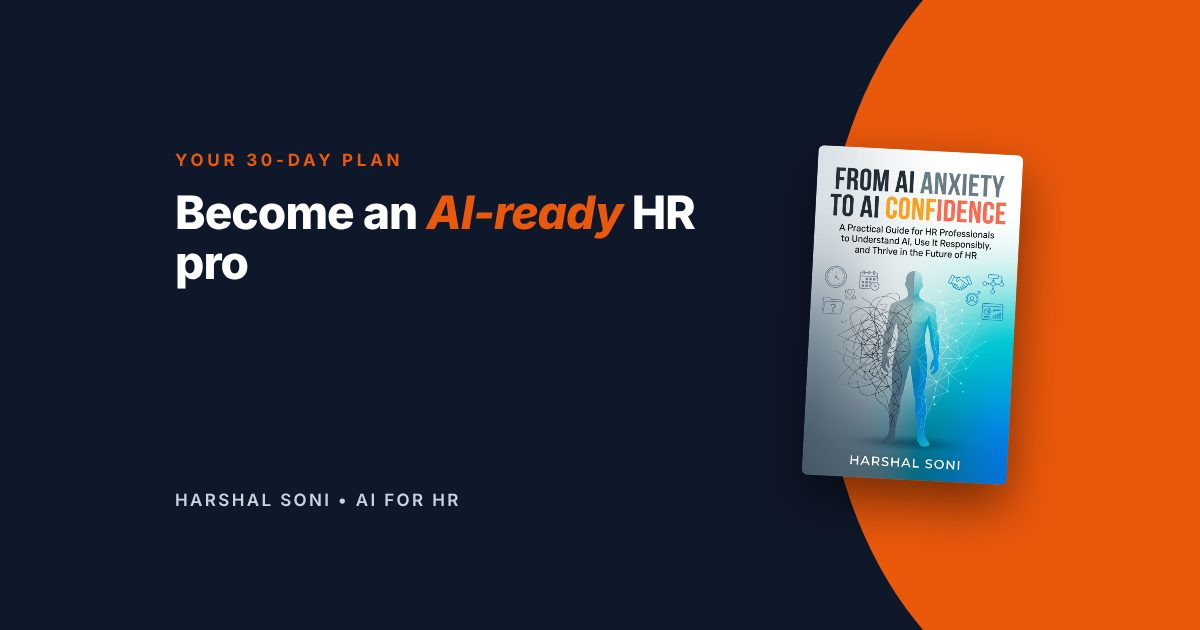
Your advantage has to be adaptability. That is what it means to be an AI-ready HR professional, and it is the idea behind the final chapter of my book, From AI Anxiety to AI Confidence.
What an AI-ready HR professional looks like
An AI-ready HR professional doesn’t know everything. They know how to learn.
- They don’t accept AI output blindly. They evaluate it.
- They don’t chase every tool. They focus on useful problems.
- They don’t remove people from important decisions just because automation is possible. They know where judgment matters.
- They don’t treat responsible AI as someone else’s job. They know trust is part of HR.
Step 1: Rate your AI confidence
Score yourself from 1 to 5 on each of these ten areas:
- Understanding AI basics
- Writing useful prompts
- Evaluating outputs
- Identifying HR use cases
- Understanding AI risk
- Protecting confidentiality
- Measuring AI value
- Explaining AI to others
- Designing AI-assisted workflows
- Continuing to learn
Repeat the assessment every three months. Confidence should be connected to capability, and a score you can track keeps it honest.
Step 2: Follow the 30-day AI confidence plan
Week 1: Understand
- Identify three HR tasks where AI may be useful.
- Find out which AI tools your organization approves.
- Run three low-risk experiments.
Week 2: Practice
- Use the CLEAR prompt framework.
- Create five reusable prompts.
- Review every output with the HUMAN checklist: harm, unsupported claims, missing context, accuracy and necessary human judgment.
Week 3: Apply
- Choose one repeatable HR workflow.
- Use AI to improve one part of it.
- Track time, quality, corrections, risks and how much human involvement was needed.
Week 4: Demonstrate
- Document what you learned.
- Share an appropriate lesson with your team.
- Pick your next AI development goal.
Thirty days won’t make you an expert. It can make you significantly more capable, and it gives you evidence of progress you can show.
Step 3: Write your personal AI operating principles
Technology changes faster than habits and culture, so decide what you stand for before the next tool arrives. Write five rules that will guide your AI use. Here are mine as a starting point:
- I will protect confidential information.
- I will verify important outputs.
- I will keep humans responsible for meaningful people decisions.
- I will use AI to strengthen, not replace, professional judgment.
- I will keep learning through small experiments.
Principle one is easier to keep when you run the SAFE check before you paste anything into an AI tool. Knowing what you stand for makes uncertainty easier to navigate.
Start this week
Don’t wait for the perfect moment. Rate yourself today, pick three tasks and run your first low-risk experiment. Small, repeated practice is what builds confidence.
This post is adapted from the final chapter of From AI Anxiety to AI Confidence. The book also includes 30 common AI use cases for HR, a day-by-day 30-Day AI Confidence Challenge, and a conversation guide for your HR team.
